10 Moments of Wisdom That Show Why Kindness and Compassion Leave a Lasting Mark (USA Edition)
People
08/17/2026


Miracles don’t always look extraordinary. Sometimes they’re a stranger offering help, a neighbor showing mercy, or someone choosing compassion when anger would be easier. American research in psychology suggests that kindness and compassion can support emotional well-being, strengthen social connection, and encourage prosocial behavior. These 10 inspiring moments from everyday American life show how love, mercy, and simple acts of kindness can create meaningful change when people need it most.
- My six-year-old son came home from his dad’s house with a drawing: a woman with long hair, floating between two lines he explained were walls. “She lives there,” he said cheerfully, and went back to his crackers. I filed it under active imagination and moved on.
A week later my ex’s new girlfriend called me, voice stripped of its usual composure. “Come now. You have to see this.” I drove over expecting something minor. I walked in and my whole body went stiff.
Every wall in the hallway was covered in drawings — not my son’s this time — all of them, layered and faded, drawn in pencil so light you’d miss them unless the afternoon sun hit exactly right. Women, children, dates, names. Dozens of them, floor to ceiling, going back what looked like decades.
The girlfriend, Renee, was standing in the middle of it with a flashlight. “I was repainting,” she said. “Peeled back the first layer and found another layer under it. And another under that.” The house was a 1940s craftsman my ex had bought at auction, previous owners unknown beyond a chain of estate sales.
Someone had been drawing on these walls for a very long time, covering them over, drawing again. The name that appeared most frequently, in the oldest and faintest layer, was Eleanor.
Our neighbor two doors down, a retired archivist named Pat who’d lived on the street for forty years, identified the name immediately when Renee knocked to ask. Eleanor Marsh had owned the house from 1947 until 1989, Pat said — a quiet woman, never married, who’d filled the house with what Pat described as “her people,” meaning the drawings.
She’d lost her entire immediate family and had spent the following decades drawing them from memory on every surface she could find, covering them when guests came, uncovering them when she was alone. “She didn’t want anyone to think she was strange,” Pat said. “But she couldn’t bear for their faces to disappear.”
My son had seen something in the walls that the rest of us had walked past without noticing — the ghost of forty years of love and grief and quiet devotion to people who were gone. We spent a weekend carefully photographing every layer before Renee repainted. Pat helped identify several of the faces from old neighborhood photos.
A local historical society took the documentation and traced two of Eleanor’s relatives still living in Ohio, who’d had no idea the drawings existed. They drove out the following month. Stood in that hallway with printed photographs of the walls and cried in the uncomplicated way people cry when something lost turns out to have been preserved after all.
My son asked me afterward why the lady drew so many pictures. “Because she missed her family,” I said. “Drawing them made her feel like they were still close.” He thought about that seriously. “Like how I draw you when I’m at Daddy’s?” I looked at him for a moment. “Exactly like that,” I said.
Some kindness spans decades without knowing it — a woman drawing faces on walls, a child seeing what adults walk past, a neighbor who remembers a name. Compassion doesn’t always arrive in time to help the person who needed it most. But sometimes it finds its way to the people who needed to know they were loved, even forty years too late. That counts. It still counts.


- I once bought a gift card, a jug of water and some fruit for a person panhandling outside of a grocery store. It really wasn’t a huge deal but the dude who was parked right next to the guy and ignoring him the whole time said, “That was really nice of you.” I just responded that the guy was a part of our community and everyone needs compassion — life is hard.
I remember when I was a child and my mom and brother and I only ate dinner because of a kind stranger who showed us that same compassion. I only hope I helped the man eat a yummy dinner and gave him the same feeling of value that stranger gave me so many years ago. © mypancreashatesme / Reddit
- My son came to me at sixteen with a problem he’d been carrying for months, something that had gone wrong with a friendship in ways that had costs on all sides, and I could see how much it had taken him to bring it to me.
I didn’t offer solutions. I asked him what he’d already tried and what he thought the other person might be feeling and what he wanted the outcome to be, and he worked through it slowly and found his own way to an answer.
As he was leaving the room he turned back and said, “You didn’t tell me what to do.” I said no. He said, “Good. I needed to know I could figure it out.”
I’d spent sixteen years being afraid of the moment he’d come to me with something I couldn’t fix. It turned out the best thing I could offer was the room to fix it himself. I should have trusted that earlier. I think he always knew I would eventually.
- I was traveling in Mexico, one of my first times outside the U.S., and at the time I spoke essentially no Spanish. I scratched my cornea, which for the lucky among you who don’t know is indescribably painful.
After literally 72 hours with no sleep due to the pain, I finally deliriously admit to myself I’m going to have to see a doctor, and thus cut my super low budget trip short. I walk into a sunglasses shop, the best thing I could think of in my state, and with the help of a phrasebook, I clumsily convey that something is wrong with my eye.
The sunglasses guy puts me on the phone with a friend who’s an eye doctor and who speaks some English. The doctor gives me detailed directions on how to get to his office on the subway from where I am, and tells me he can see me.
When I get there, I realize he’s not normally open on Sunday, and in fact he has interrupted family Sunday dinner to see me in his office which adjoins his house.
From the table next door where everyone else is still eating, his very young daughter peeks her head in a few times, and he tells me she’s learning a little English and wants to eavesdrop, but she ends up being too shy to converse.
He gets me completely patched up (literally; turns out an eyepatch is step one in stopping the pain), and gives me a prescription for some drops. I ask him, “What do I owe you?” sort of already bracing for what I assume will be the “off-hours” price and wondering if I’ll have a bus fare back to the States.
He says, “Some day, someone in your country will be in a jam, maybe they won’t speak the language too well, and they’ll need some help. That’s what you owe me.”
It’s been years and I still can’t think of that story without tearing up a little. It immediately pops into my mind whenever I’m faced with the question of whether to make a little extra time for somebody in a jam. © sozeltd / Reddit
- I grew up the child of two parents who were not well, and I spent most of my childhood being the adult in the room — managing things, making sure my younger sister was fed and at school and not scared. I didn’t know what it was to be cared for.
When I was thirteen, my school counselor called me into her office and said, “You seem like you take care of a lot.” I said I didn’t know what she meant. She said she’d noticed I always made sure my sister got on the right bus.
She said, “You’re doing a really hard thing. Do you have anyone doing that for you?” I said I was fine. She said, “I know. I’m asking anyway.” She started checking in with me once a week — not about home, just to ask how I was.
She was the first person who had ever asked about me as a separate entity from the situation I was managing. I’m a social worker now. I check in with kids who say they’re fine.
- A few years ago, I helped a friend move out of his 2nd floor apartment with a VERY narrow 90 degree turn out the door and down the stairs. Extremely hard to move anything in or out. It was a good 105 degrees that day in Dallas, and his electricity was shut off, so we had no A/C. His cups were already packed so we had no water.
We pushed on, kept moving boxes/furniture. We had to, he needed to be out that day. It was one of the most miserable days I can ever remember.
Anyway, about 3/4 done and around the corner comes a Mexican man, who had to be in his 60s or so, pushing a little ice cream cart around the complex and sees us resting exhausted beyond words.
The man walked up to us, didn’t speak a word of English, and handed us both an ice cold bottle of water from his cart, smiled, and walked off. I will NEVER forget that. © Unknown author / Reddit

- I had knee surgery and was on crutches for eight weeks, and I live in a city and use public transit, which was an education in how inaccessible the world is for people whose bodies need accommodation.
On a bad day — pain, delays, everything going wrong — a man on a crowded train cleared a space for me without being asked, reorganized the whole area around him so I could sit and extend my leg, and then calmly went back to his phone. Not heroically. Just competently, like it was a logistics problem he’d decided to solve.
When I thanked him he said, “My mother was on crutches for a year. I know how it is.” He had translated a year of watching his mother navigate the world into an automatic set of behaviors, and I was the recipient of everything he’d learned.
His mother’s difficult year had become a permanent recalibration of how he moved through space, and he didn’t even know he was handing me that inheritance.
- I was pulling off the freeway to get gas, and a woman holding a baby standing outside a minivan on the offramp reached out with one arm and a look of absolute need as I drove by. I stopped, backed up, and asked if she needed help.
Her van had broken down. She had a baby and 5 older girls in the car, on their way to a birthday party. She had been on the side of the road for 2 hours and no one would stop. Because of the age of the girls (I’d say 6ish) and the baby, she couldn’t walk to the gas station 1/2 a mile away for help without chancing one of the kids running off and getting hurt.
I handed her my cell phone, held her baby, and talked to the older girls while she made a few phone calls, then stayed with her while waiting for her help to arrive. I was so mad when I heard that no one would stop to help her.
Her husband finally arrived, looking worried, and I went on my way. © Wesa / Reddit
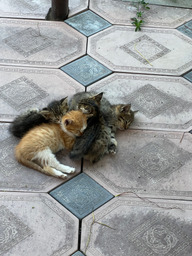
- We found him on a side of the road. He happily joined us driving home from our Europe road trip.
I see a lot of people seem to think it was someone’s cat so let me clarify. He was found in Croatia by the side of a garbage site where there’s a standard practice to dump unwanted kittens. Still today lots of people refuse to sterilize their cats so it results in huge numbers of stray kittens.
This particular photo was taken days after we started driving from there. After finding him we cleaned him, took him to the vet (even checked if he has been chipped on someone’s name). He received a vaccine, anti parasitic and a chip in my name.
We tried finding him a home there but had no luck so we couldn’t leave him behind like that. So yes, he looks clean and groomed. He has toys and a little harness. And yes, he made it safe to Sweden where we live and he’s enjoying his new home. © Paulinkica / Reddit

- My grandmother traveled alone for the first time at seventy-three, after my grandfather passed away, a week in a city she’d always wanted to see but they’d never gotten to together. The family worried loudly and she ignored us completely, booking the trip with the cheerful determination of someone who has decided that the opinion of the room is not the deciding vote.
She sent us one photo from the whole trip — herself at a café table, coffee in front of her, an expression of complete satisfaction on her face, and on the back she’d written: “Turns out I’m good company.”
She traveled alone every year after that until she was eighty-one. She sent one photo each time. They all had the same expression.
I have them all on my wall. I look at them when I need reminding that beginning again is available at any age to anyone stubborn enough to buy the ticket.
Comments
Get notifications
Lucky you! This thread is empty,
which means you've got dibs on the first comment.
Go for it!
Related Reads
12 Acts of Quiet Compassion That Still Bring Hope and Light to Heavy Hearts in 2026

People
07/29/2026
12 Acts of Kindness That Teach Us Strong Compassion Still Turns Loneliness Into Real Belonging in 2026

People
07/31/2026
10 Blended Family Moments That Started With Strangers and Ended With Lifelong Bonds

People
07/29/2026
12 Moments Where Kindness Found Lonely Hearts Before They Stopped Believing in Happiness

People
08/04/2026
10 Real Stories That Remind Us Kindness and Compassion Have No Price Tag

People
09/28/2026
10 Gardening Moments That Prove Small Things Can Bring Hope Back Into Our Lives

People
09/15/2026
10 Workplace Moments That Show Honesty and Respect Build the Strongest Teams

People
09/29/2026
10 Fathers Whose Compassion Reached Their Children When Pain Had Already Taken Over in 2026

People
08/06/2026
10 Grandparent Moments That Teach Us Kindness Is the Kind of Parenting Nobody Names in 2026

Family & kids
09/05/2026
15 Family Moments That Teach Us Why Quiet Kindness and Compassion Says More Than an Apology

People
09/09/2026
10 Moments of Wisdom That Show Why the Strongest Hearts Choose Kindness, Empathy and Forgiveness

People
09/12/2026
10 Quiet Acts of Kindness From American Strangers Who Never Got the Chance to Be Thanked

People
08/14/2026
